
.jpg)
Published Date:
April 21, 2026
Updated Date:
August 25, 2026

A walkthrough of the FASB's eight-step standard-setting process and the due-process principles that shape U.S. GAAP.
.jpg)
Critics and proponents alike often describe the FASB’s standard-setting process as painstakingly slow. In an environment where financial markets and technology evolve rapidly and new transactions emerge constantly; the FASB continues to operate at its own pace. However, that pace is intentional. At the same time, the process is not inflexible. For narrower or more time-sensitive issues, the FASB can act through the Emerging Issues Task Force (EITF), which helps the Board address certain matters on a more targeted timetable. Recent projects also show that the Board has become more responsive than it was in earlier decades. For example, the FASB’s project on crypto assets moved from added agenda discussions to final issuance in a comparatively compressed period, culminating in ASU 2023-08. While the Board remains deliberate by design, it has shown a greater ability to move quickly when circumstances warrant it.
The FASB’s role is to produce standards that are reliable, consistent, and decision useful. These standards are intended to improve financial reporting for investors, lenders, and other creditors, while also helping preparers, practitioners, and auditors apply U.S. GAAP more consistently in practice. In doing so, standard setters aim to ensure that information faithfully represents underlying economic activity while remaining relevant for decision-making.
Each update to the Accounting Standards Codification has the potential to affect how billions of dollars are reported in the financial statements of firms following U.S. GAAP. The FASB follows a structured process designed to ensure that new standards are thoroughly evaluated before they are issued. While iterative in practice, the process can be summarized as follows:
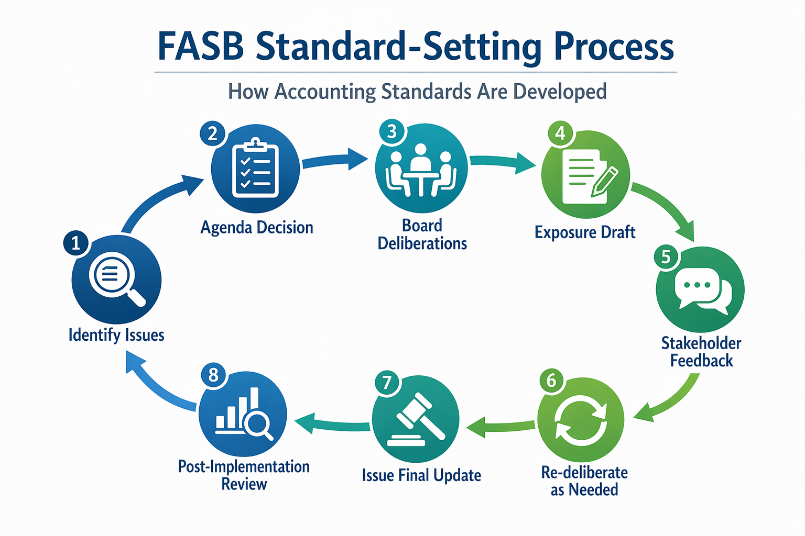
Image generated by ChatGPT.
The FASB identifies financial reporting issues through research, stakeholder feedback, emerging business practices, and its broader agenda consultation process. One important tool at this stage is the Invitation to Comment (ITC), a staff-authored discussion document used to solicit input on potential standard-setting topics, active projects, and other strategic or procedural matters. In practice, agenda consultations have been used periodically to help the Board assess which issues are most significant and where its resources should be directed.
After an issue is identified, the Board evaluates whether it should be added to the FASB’s agenda. Not every issue moves directly to the technical agenda. In many cases, a topic is first added to the research agenda, where the Board and staff study the issue further before deciding whether formal standard setting is warranted. If the Board determines that action is appropriate, the project may later move to the technical agenda.
Once a project is added, the Board deliberates the issue in public meetings that are open for observation and often webcast. These meetings provide transparency into how the Board evaluates alternatives and considers stakeholder perspectives. The FASB staff plays a significant role throughout this process by conducting research, developing analyses, preparing materials for Board discussion, and helping the Board evaluate possible approaches before tentative decisions are reached.4
The FASB issues an Exposure Draft (ED) outlining proposed changes to U.S. GAAP. This document includes the proposed guidance, background information, and the Board’s reasoning, and serves as a formal invitation for public input.4
Stakeholders respond through comment letters, public forums, and roundtables. All comment letters are made publicly available, and summaries of feedback are incorporated into the FASB’s public record. This stage enables the Board to identify practical implementation challenges.4
After receiving feedback, the Board re-deliberates the proposal in additional public meetings. At this stage, the Board considers the concerns raised by stakeholders, weighs possible revisions, and refines the proposed guidance before deciding whether and how to proceed to a final standard.4
If the Board reaches final conclusions, it issues an Accounting Standards Update (ASU), which formally amends the Codification. The ASU includes a Basis for Conclusions that explains the Board’s key decisions and how stakeholder feedback was considered, providing greater transparency into the outcome.4
For selected standards, the process continues after issuance through post-implementation review. This review evaluates whether the standard is achieving its intended purpose, whether the benefits justify the related costs, and whether the standard-setting process itself can be improved. In that sense, the process is best understood as a loop rather than a straight line, with lessons from implementation helping to identify future issues for the Board to consider.4
The structure of the FASB’s process reflects both the complexity of financial reporting and the wide range of stakeholders affected by accounting standards. At the core of that structure is the Board’s commitment to due process. Due process helps ensure that standard setting is open, orderly, and inclusive of a wide range of perspectives, while also reinforcing objectivity, cost-benefit consideration, and consistency with the conceptual framework. Together, these features help the FASB produce standards that are both conceptually sound and practical to apply.4
First, a deliberate process helps the FASB get the answer right. Accounting standards affect a wide range of stakeholders and often govern complex transactions, so the Board cannot afford to move too quickly at the expense of sound judgment. Public deliberation, repeated analysis, and stakeholder input help the FASB evaluate alternatives carefully and refine guidance before it is finalized.4
Second, once the Board has reached the right answer, the process also helps reduce disruption in practice. Companies need time to interpret new guidance, update systems, revise internal controls, and train personnel. By pairing new standards with transition provisions and effective dates, the FASB allows for more orderly implementation.4
Third, the process ensures a balance between benefits and costs. While improved financial reporting is valuable, the FASB considers whether the costs of implementation are justified relative to the benefits provided to users of financial statements.4
Finally, the process helps ensure that standards are operational. Accounting guidance must be clear enough to be applied consistently and audited effectively. Extensive deliberation and stakeholder feedback help identify and resolve practical issues before a standard is finalized.4
The FASB’s standard-setting process is intentionally rigorous. While it may take time, this approach is essential to maintaining trust in financial reporting.
The FASB’s standard-setting process is intentionally rigorous. While that process can take time, it helps the Board develop standards that are both technically sound and practical to apply. In that sense, the value of the process is not speed alone, but the confidence it gives market participants that new guidance has been carefully considered before it becomes part of U.S. GAAP.
Repairing the US Financial Reporting System
Accounting for and Disclosure of Crypto Assets