

Published Date:
November 3, 2026
Updated Date:
November 3, 2026

Could quarterly reporting become optional? Explore the SEC’s proposed shift to semiannual reporting and its implications for investors.

For decades, quarterly reporting has been a standard part of the U.S. public company reporting system. Public companies subject to Section 13(a) or Section 15(d) of the Exchange Act generally file three quarterly reports on Form 10-Q throughout the year, followed by an annual report on Form 10-K.1 In May 2026, however, the Securities and Exchange Commission proposed a significant change to that framework: allowing public companies to elect to report semiannually instead of quarterly. Under the proposal, companies choosing semiannual reporting would file one new Form 10-S during the year, followed by their annual Form 10-K.1
Although the proposal would change the frequency of required interim reports, it would not necessarily mean that investors would hear from companies only twice a year. Companies could still choose to issue quarterly earnings releases or hold quarterly earnings calls.1 Instead, the proposal raises a broader question about how frequently public companies should be required to provide standardized financial information and whether the benefits of quarterly reporting justify the time and cost associated with preparing those reports.
The SEC’s proposal has therefore renewed a long-running debate over the appropriate balance between reporting flexibility and timely investor information. Supporters argue that less frequent mandatory reporting could reduce compliance burdens and allow management to focus more on long-term performance, while critics have raised concerns that investors could receive important financial information less frequently.1 With the formal comment period now closed and the proposal still pending, the debate offers an opportunity to consider how a shift to optional semiannual reporting could affect public companies, investors, auditors, and the broader financial reporting environment.
Semiannual reporting is not a new concept in the U.S. public company reporting system. In 1955, the SEC adopted Form 9-K, which required certain financial information to be reported on a semiannual basis. That framework remained in place until 1970, when the SEC adopted Form 10-Q and established the quarterly reporting structure that public companies generally follow today. Even before quarterly reporting became mandatory, however, many public companies were already providing quarterly information voluntarily or because of stock exchange requirements.1
Questions about whether quarterly reporting remains the most appropriate model have resurfaced periodically. In December 2018, the SEC issued a request for comment examining the relationship between quarterly reports and earnings releases, including whether the existing reporting system could be made more efficient while continuing to protect investors.3 The SEC also sought feedback on reporting frequency and whether the current system might contribute to an excessive focus on short-term results. Importantly, the 2018 action was a request for public input rather than a specific proposal to permit semiannual reporting.3
Those earlier discussions preceded a more concrete rulemaking effort. On May 5, 2026, the SEC formally proposed amendments that would allow public companies to satisfy their interim reporting obligations by filing a new semiannual Form 10-S instead of quarterly reports on Form 10-Q. The proposal represents a more significant step than the SEC’s earlier requests for feedback because it provides a specific framework for how optional semiannual reporting could operate if the rule is ultimately adopted.1
On May 5, 2026, the SEC proposed amendments that would allow public companies subject to Exchange Act reporting requirements to elect to file semiannual reports instead of quarterly reports. Under the current system, public companies generally file three quarterly reports on Form 10-Q and one annual report on Form 10-K each fiscal year. Under the proposed alternative, a company that elects semiannual reporting would instead file one new Form 10-S covering the first six months of the fiscal year, followed by its annual Form 10-K. Companies that prefer the existing quarterly reporting structure could continue filing Form 10-Q.1 The difference between the current and proposed reporting structures is illustrated below.
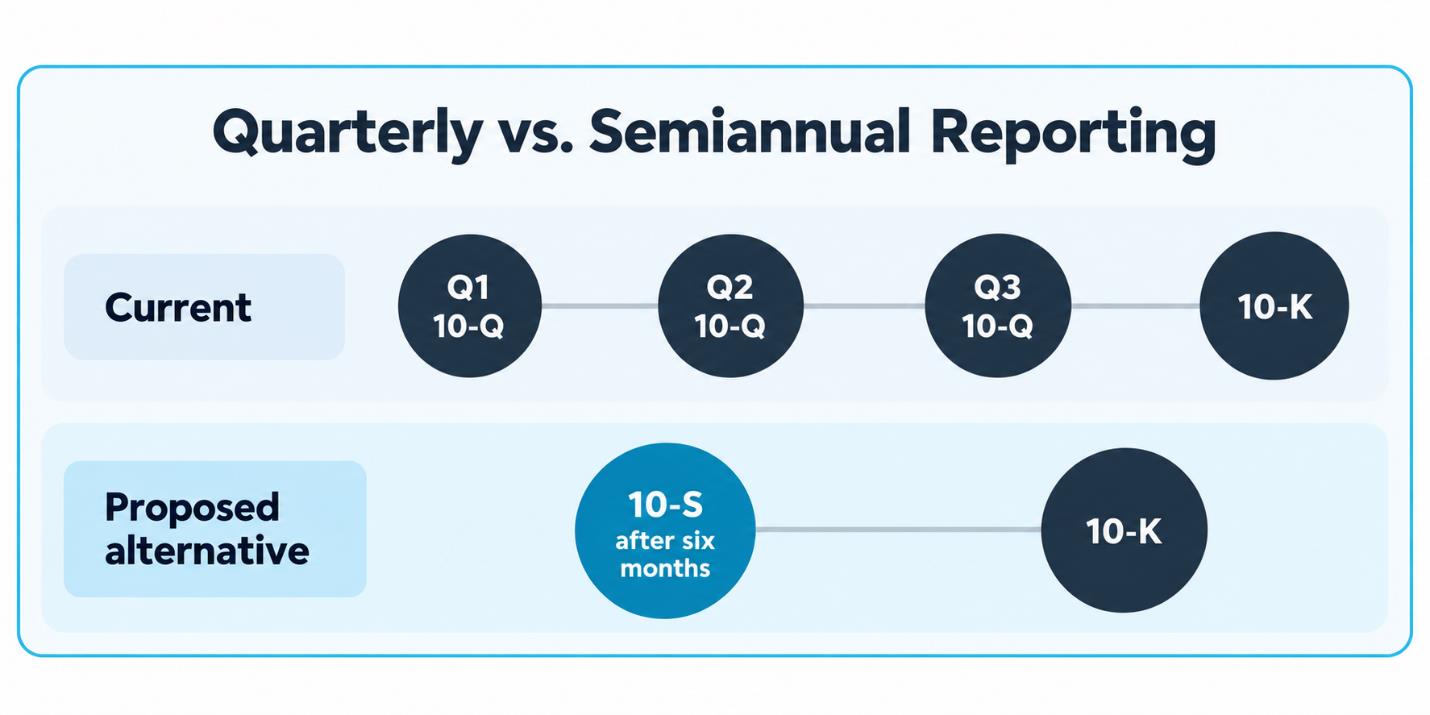
The proposed Form 10-S would be due 40 days after the end of the company’s first semiannual period for large accelerated filers and accelerated filers, and 45 days after the end of the period for other issuers.4 The SEC also proposed corresponding changes to Regulation S-X to accommodate the new reporting frequency and related financial statement requirements.1
Importantly, electing semiannual reporting would not eliminate other forms of company disclosure. Current reporting requirements, including applicable disclosures on Form 8-K, would remain in place. Companies could also continue issuing quarterly earnings releases or holding quarterly earnings calls if they chose to do so. The SEC has emphasized that the proposed changes would affect the required frequency of periodic reporting, rather than dictate how frequently companies communicate with investors through these other channels.1
By making semiannual reporting optional rather than mandatory, the proposal would allow companies to determine which reporting cadence best fits their circumstances. The SEC has identified factors such as preparation costs, management time, investor expectations, cost of capital, a company’s stage of development and business model, and the availability of other disclosure channels as considerations that could influence that decision.1
Reporting frequency matters because it determines how often investors receive standardized financial information about a company’s performance and financial condition. Quarterly reports provide regular updates through financial statements, Management’s Discussion and Analysis (MD&A), and other required disclosures. If a company elected semiannual reporting, investors would receive those comprehensive periodic updates less frequently, even though other disclosure requirements, such as Form 8-K filings, would continue to apply.1
At the same time, preparing quarterly reports requires significant time and resources from accounting and finance teams, management, legal and compliance personnel, audit committees, and external auditors. The SEC has identified preparation costs, management time, and reporting burden as factors that companies may consider when determining whether quarterly or semiannual reporting better fits their circumstances. For some companies, reducing the number of required interim filings could meaningfully change the amount of effort devoted to the reporting process.1
The proposal also reflects the fact that public companies differ significantly in their business models, stages of development, investor expectations, and information needs. A reporting cadence that is useful for one company may not provide the same value for another. By making semiannual reporting optional, the SEC’s proposal raises a broader question about whether every public company should be required to follow the same reporting frequency.1
Ultimately, the significance of the proposal extends beyond simply replacing one SEC form with another. Changing reporting frequency could affect the timing of information available to investors, the costs companies incur to meet reporting requirements, and the way companies communicate with the market.1
The debate over semiannual reporting centers on how the competing interests of reporting frequency, compliance burden, and access to standardized financial information should be balanced.
Supporters of the proposal argue that quarterly reporting can require significant time and resources from accounting teams, management, legal personnel, audit committees, and external auditors. Reducing the number of required interim filings could lower compliance costs and allow companies to devote more resources to other business priorities. The SEC has also emphasized that public companies differ in size, business model, stage of development, and investor base, which may mean that a single reporting frequency is not equally useful for every company.1
Supporters also argue that less frequent mandatory reporting could reduce pressure on management to focus heavily on short-term quarterly results. From this perspective, semiannual reporting could encourage greater attention to long-term strategy, investment, and operating performance rather than meeting near-term market expectations. However, research on whether quarterly reporting actually causes short-term decision-making is mixed, so this remains an important area of debate rather than a settled conclusion.1,3
Opponents argue that semiannual reporting would reduce the frequency of comprehensive, standardized financial information available to investors. Longer gaps between periodic reports could make it more difficult to monitor changes in a company’s financial condition, liquidity, operating performance, and risk exposure. Although companies would still file Form 8-K for certain material events and could voluntarily issue quarterly earnings releases, those disclosures do not necessarily provide the same breadth of information as a Form 10-Q.1
Another concern is information asymmetry. Some opponents argue that less frequent required reporting could place retail investors at a disadvantage relative to company insiders and large institutional investors that may have access to more extensive research and information resources. Quarterly filings provide a standardized source of information that is available to all investors at the same time.1
Opponents have also raised comparability concerns. If some companies continue reporting quarterly while others elect semiannual reporting, investors and analysts may have more difficulty comparing companies within the same industry or peer group on a consistent basis. This could make differences in reporting frequency another factor investors must consider when evaluating company performance.1
Ultimately, the disagreement is not simply about whether financial reporting is costly or whether investors benefit from timely information. The central question is how frequently companies should be required to provide comprehensive financial information and whether giving companies greater discretion over that frequency would improve the reporting system or weaken an important source of transparency.
According to an independent tracker of the SEC comment docket, the public response to the semiannual reporting proposal has been heavily weighted against the change. The tracker found that the overwhelming majority of letters classified as taking a position opposed optional semiannual reporting.2
Many opponents focused on the potential loss of timely and standardized financial information. Investors argued that quarterly reports allow them to regularly evaluate changes in a company’s financial condition, operating performance, liquidity, and risks. Moving to semiannual reporting would create longer periods between comprehensive periodic filings, which some commenters believe could make it more difficult for investors to respond to changes in a company’s performance.2
Another recurring concern was the potential effect on retail investors. Several commenters argued that individual investors depend heavily on publicly available SEC filings because they may not have the same access to management, proprietary or paid research, alternative data, or other information resources available to large institutional investors. From this perspective, reducing the frequency of required reporting could increase information asymmetry between different groups of market participants.2
Institutional investors and market participants also raised concerns about transparency and comparability. For example, the Managed Funds Association urged the SEC to withdraw the proposal, while Citadel argued that differing reporting frequencies could reduce market transparency and make it more difficult for investors to compare companies consistently.5,6
According to the independent tracker, supportive commenters generally emphasized potential reductions in compliance costs, management time, and reporting burden, as well as the value of allowing companies to choose the reporting frequency that best fits their circumstances. However, the tracker indicates that the overall public comment record has been dominated by concerns about investor access to information, transparency, and comparability.2
With the formal comment period having closed on July 6, 2026, the SEC's semiannual reporting proposal has entered the next stage of the rulemaking process.1 The proposal remains pending as the Commission evaluates public feedback and considers whether to move forward with the proposed changes.2
The Commission could adopt a final rule substantially similar to the proposal, revise certain provisions before adoption, or decide not to adopt the proposal. There is currently no announced date for a final decision or Commission vote on semiannual reporting.1
The interactive timeline below shows the major stages of the SEC rulemaking process and where the semiannual reporting proposal currently stands. Select a step to learn more.
Until the SEC adopts a final rule, the existing quarterly reporting requirements remain in place. Public companies therefore must continue following the current Form 10-Q reporting framework. If the SEC ultimately adopts the proposal, the final rule would specify when the new requirements become effective and when companies could begin electing semiannual reporting.1
Given the volume of public comments and the significant concerns raised by investors and other market participants, the next stage of the rulemaking process will be important to watch. Any final action will show how the SEC balances its goal of providing companies greater reporting flexibility with concerns about transparency, comparability, and timely access to financial information.